Global Western Art Music Network
.png)
Date: Feb 9, 2026
From: Dr. Michelle Assay
Event: Il barbiere di Siviglia (The Barber of Seville)
Canadian Opera Company, Production by Joan Font and Els Comediants
Another COC opening night, another revival of an old production. This time it is the turn of their 2015 Barber of Seville, originally co-produced with Houston Bordeaux and Opera Australia, by Catalan director Joan Font, in collaboration with the Spanish theatrical collective Els Comediants
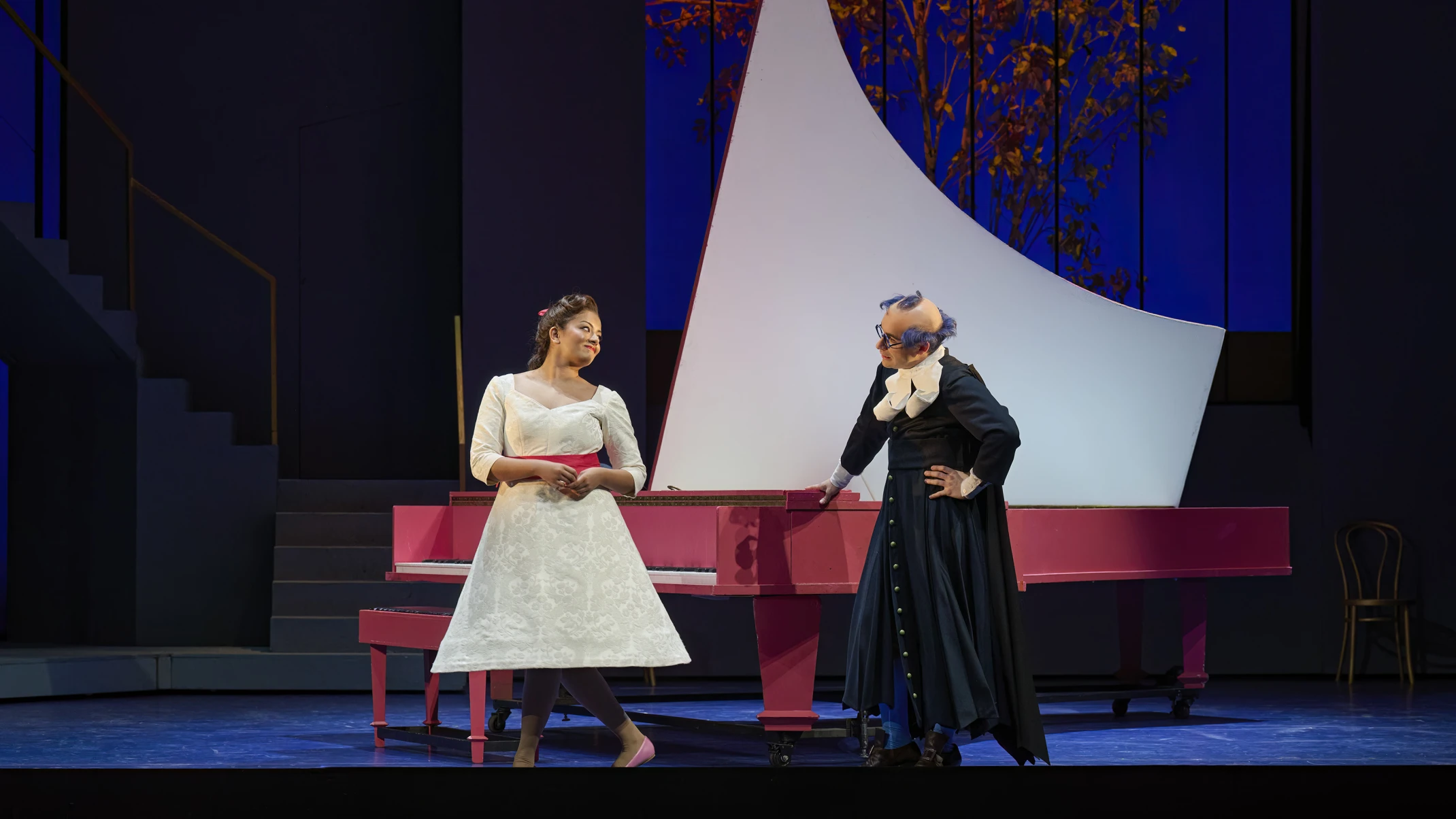
The production’s vibrant costumes and promise of circus-like spontaneity are striking at first glance. There is even a nod to Picasso in the cubist guitars accompanying Count Almaviva’s serenading of Rosina. The set seems to be attempting a Bauhausian Constructivist geometry, but in practice it remains detached and cold, almost as if the budget had been used up on hiring the supernumerary non-singing actors and designing a ginormous piano-cum-table-cum-gondola placed centre-stage from Act 2 onwards.
In Act I, a deformed cube serves as Figaro’s barber shop—its opaque surfaces lit so that we glimpse only silhouettes within—while to stage left sits a skeletal, transparent outline of Bartolo’s house, viewed from without. Despite all the bright coloured costumes and jester-ish energy, Seville itself is never convincingly evoked. There is no hint of the city’s exuberance, Andalusian warmth, or Iberian urban texture. We might as well have been watching The Barber of Hamilton, Ontario.
Costumes are a curious mish-mash: there are gestures toward Spanish 19th-century dress, a whiff of 1950s West Side Story for Rosina (looking and acting like Bernstein/Sondheim’s Maria), and a mild commedia-dell’ arte / circus flavour throughout. According to taste, this could be either a strength a weakness; but in terms of musical or dramatic effect, it feels merely half-baked. In fact, the production’s most conspicuous shortcoming is its compulsion to distract the audience from the music. There it succeeds, for sure.
At first the distraction feels like a smart idea: Figaro’s “Largo al factotum” is staged with five alter egos miming and enacting the lyrics, while Luke Sutliff delivers the aria as the Figaro standing stage left. The music’s familiarity ensures that it survives the surrounding hyper-activity. But soon the layering of visual stunts, surtitles, vocal performance and Sutliff’s own physical delivery feels chaotic and obstructive. Figaros popping in and out is one thing, but when virtually every aria and even some ensemble numbers get similar treatment, the comic effect soon wears off.
Rosina’s showpiece “Una voce poco fa” suffers likewise, with a cascade of simultaneous actions—two stocking-headed painters tackling a tree and other characters bopping through background gags. Audience laughter at these visual sideshows jars against Deepa Johnny’s acrobatic vocal pirouettes.
By Act II the formula has become predictable and routine: recitative, pause, aria, dumbshow, prop reset. The giant pink piano-shaped table—introduced as a multifunctional centrepiece—rotates and repurposes itself (from desk to extended keyboard to, inexplicably, a gondola-like vessel), each shift ostensibly designed for comic effect. Opera audiences will laugh at anything, of course. Goodness, an opera singer making a funny face: ha, ha. Throw in some falsetto: ha, ha, ha… But all this falls far short of the sparkling wit inherent in Rossini’s score. The distractions also shift the dramatic balance. The Barber, once the supremely articulate catalyst of the story, is gradually sidelined, not least by Bartolo’s caricatured inflation into pantomime villainy, further exaggerated by Renato Girolami’s relish for crude vocal effects - chuckle-worthy, to be sure, but nothing more. Dave Monaco’s Almaviva certainly enjoys the schoolboy comic effect of his various guises— especially as the drunken soldier and Don Alonso. His voice, while resonant and light, is at times (in particular in the first act) underpowered and somehow never fully recovers from the nasal tones he adopts when appearing as Don Alonso.
The music itself often feels like it’s fighting for attention. Conductor Daniela Candillari and the Canadian Opera Company Orchestra bring moments of energy and flair to Rossini’s effervescent score, yet overall the ensemble feels a touch under-fuelled and lacking the tightness the infectious rhythms invite.
Michelle Assay