Global Western Art Music Network
.png)
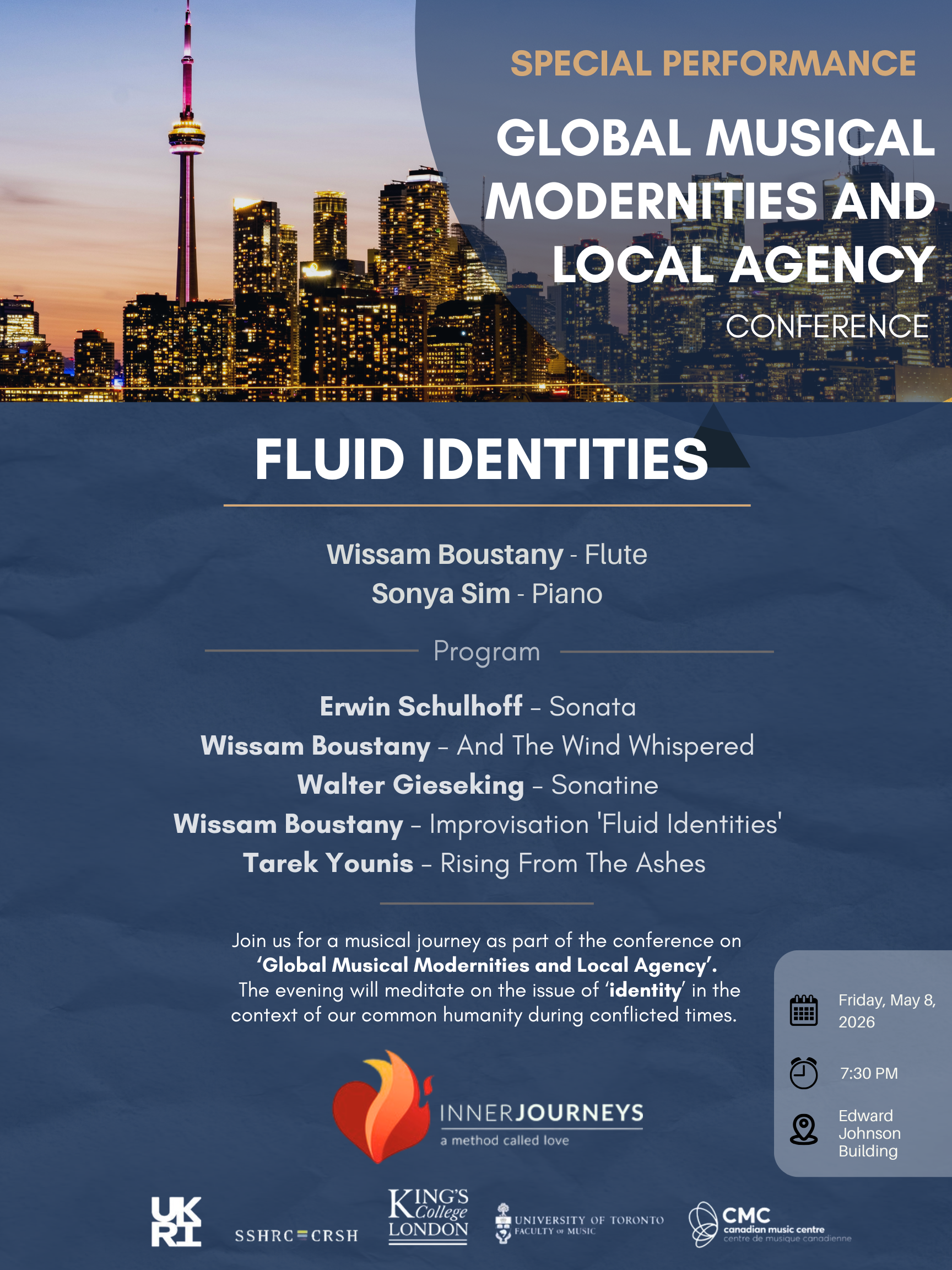
Sonata for Flute and Pianoforte (1927)
I. Allegro moderato
II. Scherzo: Allegro giocoso
III. Aria: Andante
IV. Rondo-Finale: Allegro molto gajo
“… And the WindWhispered…” for solo flute (2009)
Sonatine for flute and piano (1937)
I. Moderato
II. Allegretto
III. Vivace
Improvisation ‘Fluid Identities’
Rising from the Ashes (1996)
Erwin Schulhoff
Wissam Boustany
Walter Gieseking
Wissam Boustany
Tarek Younis
Dr. Michelle Assay will moderate a short discussion following the recital
This recital explores identity and culture as perpetually evolutionary and fluid concepts that cannot be pinned down to time, place, religion, or political perspective. This, in thecontext of our fractured common humanity ... which is held hostage by military might and those who would abuse the instinctive desire to belong.
Erwin Schulhoff (1894–1942) was born in Prague and trained as a composer in Prague, Vienna, Leipzig, and Cologne, with early encouragement from figures such as Dvořák and Debussy. After military service with the Austrian Army during the First World War, including a stint as a prisoner-of-war in Italy, he resumed his career in Germany and then returned to Prague in 1923, joining the Prague Conservatory faculty in 1929. His compositions absorbed a remarkable range of influences, from jazz, dada, and neoclassicism to twelve-tone techniques and Czech folk traditions, often combining them in striking ways. His only opera Plameny (“Flames,” 1929), for instance, is based on the Don Juan story and incorporates influences ranging from Gregorian chant through Mozart and Wagner to jazz. Of German-Jewish descent, Schulhoff increasingly aligned with Communism in the 1930s, and embraced Soviet socialist realism. Arrested by the Nazis in 1941 while planning to emigrate to the Soviet Union, he died of tuberculosis in the Wülzburg prison camp in Bavaria in 1942. Long neglected after the war, his music has since been rediscovered through renewed interest in composers suppressed by the Nazi regime.
Schulhoff’s Flute Sonata was completed in Prague on March 12th, 1927, and was published in 1928 by J. & W. Chester of London. It is dedicated to the French flutist René Le Roy, who gave the first performance of the work, with the composer at the piano, in Paris in 1927. Written in the fashionable French neoclassical style of the 1920s, with the occasional brief nod to the equally popular jazz idiom of the day, the sonata is in four compact movements, lasting just 12 minutes in performance. The opening movement is the longest of the four and is cast in a traditional sonata form structure. A brief and energetic Scherzo is then followed by a rhapsodic Aria slow movement. A playful rondo movement brings the work to an engaging close.
Wissam Boustany writes: As flute players, our creative lives are inseparable from the air we breathe and shape—the invisible element that lies at the very heart of our art. “...And the Wind Whispered...” was first performed in Botswana and Zimbabwe in February 2009, though it was not notated until 2011. Inspired by the wind itself, the piece reflects on a fractured world and carries a deeply humanistic message. I have always been very wary of organized nationalism, religion and politics because they fragment and diminish our humanity. At one point in my piece, I say "and the wind never shows its passport, when it crosses the border." Sit back and let the wind take you on a journey of its own choosing. This piece carries a wish with it—that humanity can one day rid itself from its self-imposed spiritual prisons.
“...And The Wind Whispered...” is deliberately written down in approximate notation. I provide some basic ideas, modes, melodies, sequences and atmospheres ... but it is up to the player to find their own timing, establish their own flow and connection between the various episodes, and create a free, flowing, improvised feel for the piece. Circular breathing plays an important role in sustaining this continuity, but performers who do not use the technique are welcome to find their own solutions. Each interpretation becomes a personal response to the challenge—and the invitation—to let the wind speak.
Walter Gieseking (1895–1956) was a German pianist who grew up in France and Italy and studied piano at the Hanover Conservatory in Germany with Karl Leimer from 1911 to 1913. He built a major international career as a touring concert pianist between the wars, including extensive appearances in the USA. Following postwar controversy over alleged associations with the Nazi regime, he resumed performing internationally after successfully completing denazification proceedings in January 1947. He appeared in Europe, South America, and Japan, and eventually returned to the USA shortly before his death. Gieseking was especially celebrated for his performances and recordings of Debussy, while also excelling in the music of Bach, Mozart, and Beethoven.
Those familiar with Gieseking’s reputation as a pianist may be surprised to learn that he was also active as a composer. He worked largely in a private, modest capacity, writing short piano pieces and pedagogical works for his students, rather than concert works for his own use. His compositions were never central to his public reputation and are perhaps best understood as an extension of his pedagogical activity, rather than as works of profound historical significance. The Sonatine for Flute and Piano, however, is his best-known and most frequently performed composition. It was written in 1935, published in 1937 in Berlin, and was premiered that same year by the German flutist Gustav Scheck with the composer at the piano (the two also recorded the work). The three-movement piece lasts ca. 13 minutes and combines French neoclassicism with a disciplined sense of form and clarity. It remains Gieseking’s only chamber work to have secured a place in the modern repertoire. It features a piano part that is at times demanding and brilliantly textured, rather than subservient to the lyrical flute melodic line, but overall, the work is characterized primarily by lightness and wit, rather than overt virtuoso display.
‘Fluid Identities’ is an improvised meditative work by Wissam Boustany that explores music as a metaphor for personal transformation and cultural fluidity, inviting listeners to experience identity as something dynamic and perpetually evolving—formed at the intersections of memory, place and imagination, and constantly reshaped through movement and exchange.
Tarek Younis is a musician and ethnomusicologist whose work focuses on composition, performance, and the cultural life of music in Jordan and the wider Middle East. Since completing an MA degree in ethnomusicology at The School of Oriental and African Studies, University of London in 2002, he has combined academic work with creative and curatorial projects, teaching composition and history at the University of Jordan and working as a consultant ethnomusicologist for cultural institutions in Amman.
Rising from the Ashes is heavily influenced by Arabic rhythms, modes (maqaamaat) and improvisations (mawaal), as well as traditional western idioms. It is inspired by the myth of the Phoenix, a legendary bird with supernatural powers. Sacred in ancient Egypt, the Phoenix was fabled to live 500 years or longer. At the end of that time, it built a nest from twigs of spice trees, to which it set fire. Both the bird and its nest were consumed in flames and out of the ashes a worm emerged, from which the new Phoenix grew. This theme of resurrection figures strongly in many religions, carrying a message of hope beyond despair, life after death, peace after war, or personal transformation. Wissam Boustany commissioned the work after meeting Tarek Younis while on tour in the Middle East in the early 1990s. He asked the composer, only seventeen at the time, to write a work symbolic of Lebanon rising out of the ashes of a devastating war.
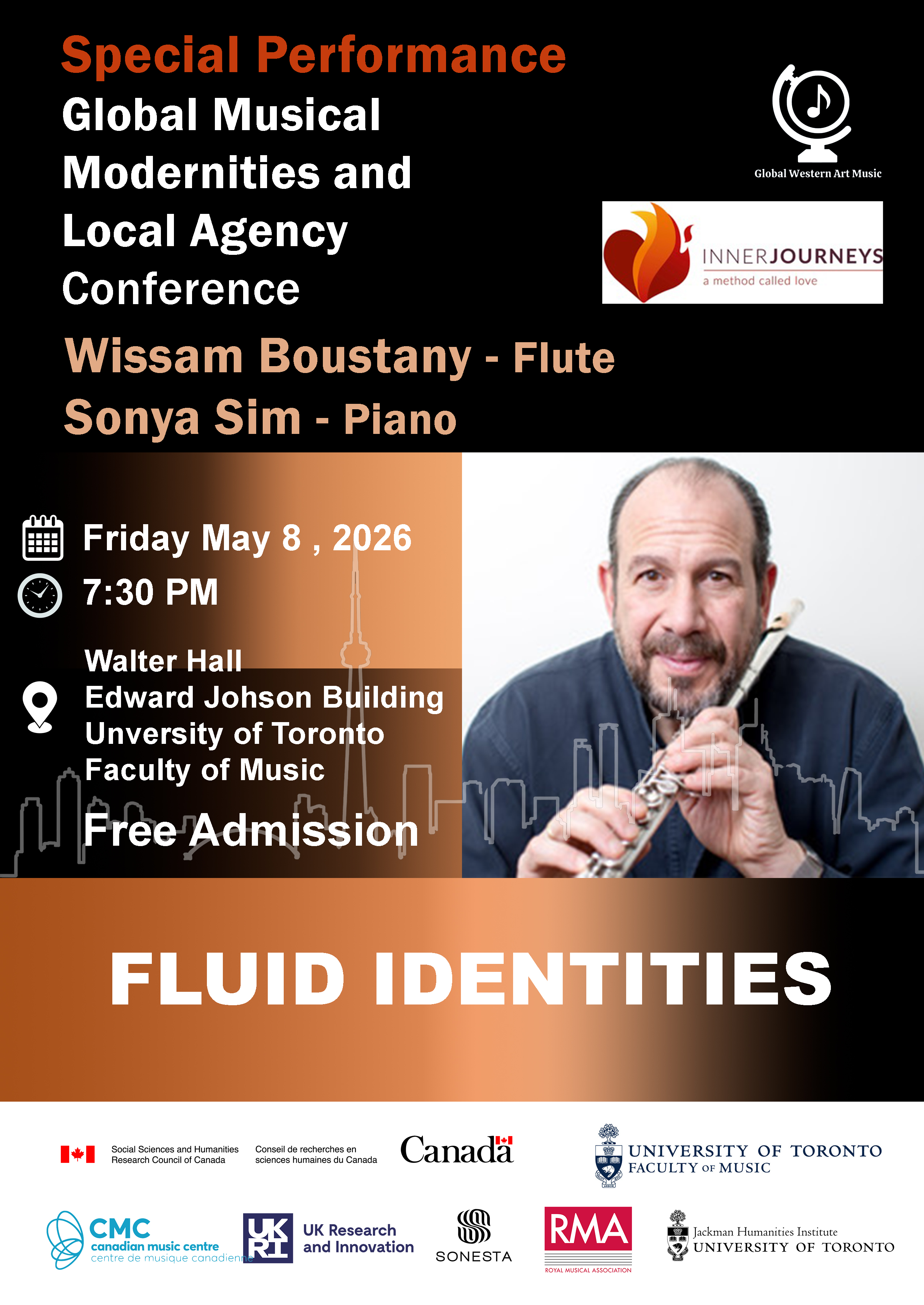
Wissam Boustany is an internationally acclaimed flutist whose passionate musicality and charismatic stage presence have earned him a unique reputation across a wide range of genres, from Baroque and classical repertoire to contemporary music, jazz, and improvisation. Known for imaginative programming and a highly expressive style marked by tonal subtlety, colour, and emotional depth, he has appeared as a soloist with leading orchestras and conductors worldwide and has collaborated closely with many composers, enriching the modern flute repertoire. His artistry is documented on critically acclaimed recordings for Nimbus Alliance and Chandos. Born in Lebanon and educated in Britain, his musical outlook has been profoundly shaped by his own early experiences of war, leading to a lifelong commitment to music as a vehicle for healing and human connection. In 1995 he founded Towards Humanity, an international initiative that uses music and education to support communities affected by war and conflict. He is a devoted teacher and mentor, having taught for many years at Trinity Laban and the Royal Northern College of Music. His pedagogical approach, known as A Method Called Love, emphasizes improvisation, memory, self-reliance, and compassion as being at the heart of music-making.
Sonya Sim is a Toronto-based collaborative pianist who appears regularly in recitals, concerts, and masterclasses across the Greater Toronto Area. She is an established collaborator with wind, brass, and vocal musicians, and is frequently engaged for concerts at the University of Toronto Faculty of Music across a wide range of repertoire, especially music for flute and piano.
We wish to acknowledge this land on which the University of Toronto operates. For thousands of years, it has been the traditional land of the Huron-Wendat, the Seneca, and the Mississaugas of the Credit. Today, this meeting place is still the home to many Indigenous people from across Turtle Island and we are grateful tohave the opportunity to work on this land.
As part of the Faculty’s commitment to improving Indigenous inclusion, we call upon all members of ourcommunity to start/continue their personal journeys towards understanding and acknowledging Indigenouspeoples’ histories, truths and cultures. Visit indigenous.utoronto.ca to learn more.
